As an Amazon Associate this site earns from qualifying purchases.
Quick Picks
Disclosure: We earn a small commission from qualifying Amazon purchases at no extra cost to you.
As an Amazon Associate, we earn from qualifying purchases.Last Updated: September 2026
Here's the thing about building a pickleball court at home or in a shared gym: the paddle is the easy purchase. The net and the lines are where people waste money, because a net that sags mid-rally or a set of lines that curls under a sneaker will quietly ruin every session you play on it.
This guide walks through what actually matters in a court setup — the published dimensions you are trying to hit, the difference between a portable net and a fixed post system, and how the three main line-marking approaches (fabric throwdown lines, adhesive tape, anchored webbing) behave on driveways, hardwood and grass. Every specification below comes from the manufacturer's own listing, and this website does not do product research, so you will see figures attributed to whoever published them rather than dressed up as something measured here.
By the end you should be able to spec your own setup — surface first, net second, lines third — instead of guessing from a product photo.

- 22FT or 11 FT Pickleball Net - BAGAIL's latest portable pickleball net features two nets - a full-size (36 "H x 22'W) USAPA regulation net and an 11'W half court practice net
- Exclusive Ball Collector & Added Portability - Designed to be convenient for pickleball enthusiasts, it is equipped with a exclusive ball collector to keep your pickleballs

- 22ft Regulation Size, Play Like a Pro: Our pickleball net system meets the official 22ft size as specified by USAPA regulations, making it ideal for both competitive matches and
- Anti-Sag, Always Tight: Featuring a built-in hand winch and reinforced tension rope, this net lets you easily fine-tune net tightness, keeping it game-ready at all times
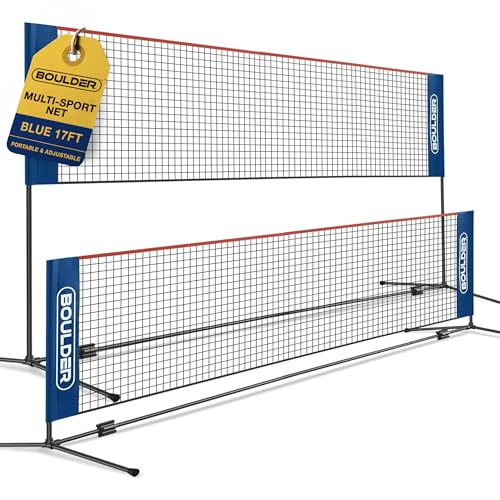
- 17FT NET – Best for outdoor open spaces. Designed for 2-on-2 play, making it perfect for doubles matches and family fun
- MULTI-SPORT NET – More than just a badminton net! With foldable poles, the net height can be easily adjusted (34-60 inches), making it perfect for pickleball, tennis, soccer

- Easy setup, no measuring, marking or assembly required
- Compact. Rolls up to about the size of a shoebox

- ONE ROLL COVERS A FULL COURT - Each 230FT roll is designed to lay out one complete USAPA regulation indoor pickleball court with a little spare. No piecing together short rolls
- MADE FOR INDOOR GYM FLOORS - Formulated to bond securely to smooth indoor surfaces like hardwood, vinyl, and finished gym floors. Ideal for churches, schools, community centers
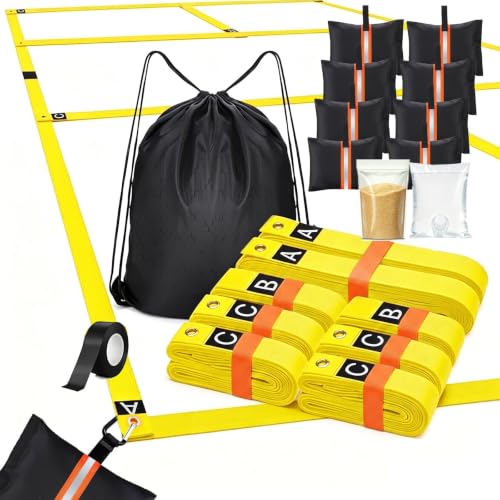
- OFFICIAL SIZE & ZERO MEASURING: Practice like a pro with our exact 44ft x 20ft regulation size pickleball court lines. No tape measure needed! Meeting official standards, this kit
- HEAVY-DUTY & ANTI-SLIP SAFETY: Engineered from durable nylon, these pickleball court markers withstand heavy traffic. Unlike cheap rubber throwdown lines that curl, our textured
What Counts as a Pickleball Court Setup?
A pickleball court setup is three things: a marked playing rectangle, a net that spans it at the correct height, and enough surrounding run-off space to chase a ball without hitting a fence or a car. Everything else — paddles, balls, portable fencing, lighting — is an accessory to those three.
The playing rectangle is the number to anchor on. One court-marking kit in this guide is published as an exact 44 ft x 20 ft regulation size pickleball court line set, and that 44 x 20 footprint is the space your driveway or gym bay has to contain before anything else matters.
Run-off is where driveway projects fail. If you only have 44 x 20 of flat surface, you have a court with zero out-of-bounds room, which is playable for casual dinking but cramped for anything competitive.
Pickleball Court Dimensions and Net Height
The short answer: plan for a 44 ft x 20 ft court, and a net that spans the 20 ft width with height set at the sidelines. That 44 ft x 20 ft figure is published as the regulation size by the manufacturer of the anchored line kit reviewed below.
On the net side, the BAGAIL net set is listed as a full-size 36"H x 22'W USAPA regulation net, and the TYRSEN listing likewise describes 22 ft as the official size specified by USAPA regulations. Note what that means in practice: the net system is wider than the 20 ft court so the posts sit outside the sidelines rather than in the field of play.
One caution. Regulation pickleball nets are lower at the center than at the posts, and none of the supplied listings state a center-strap height, so confirm the exact center measurement against the current USA Pickleball rulebook before you set tension for league or tournament play.
How much total space should you clear?
- Playing surface: the 44 x 20 rectangle itself.
- Baseline run-off: extra depth behind each baseline for deep returns — more matters more.
- Sideline run-off: room for the net posts, which sit outside the 20 ft width on a 22 ft net frame.
- Overhead and obstruction check: basketball hoops, low branches, gutter downspouts and parked vehicles.
- Slope check: any driveway pitch will bias serves and ball bounce toward the low end.
Types of Pickleball Court Equipment Explained
| Equipment type | How it works | Best suited to | Main trade-off |
|---|---|---|---|
| Portable regulation net (22 ft) | Freestanding metal frame at full court width, often on wheels | Driveways, gyms, clubs that share the space | Takes storage space; frame quality determines sag |
| Multi-sport adjustable net | Height-adjustable poles serving several sports | Families playing pickleball plus badminton or tennis | Adjustability can come at a narrower width than regulation |
| Permanent post system | Posts set into ground sleeves or footings | Dedicated courts you never reconfigure | Not portable, not renter- or HOA-friendly |
| Fabric throwdown lines | Pre-sized thin fabric lines laid over the surface | Renters, HOA driveways, quick pack-down | Relies on the surface being flat and clean |
| Adhesive marking tape | Tape applied directly to a smooth floor | Gyms, churches, schools, community centers | Surface-specific; intended for smooth indoor floors |
| Anchored webbing kit | Webbing lines held by sandbags, water bags and tape | Windy outdoor courts, grass, parking lots | More parts to deploy and carry than a plain roll |
Portable vs permanent pickleball net
Permanent posts win on stability and on never having to set anything up. Portable wins on everything else for most readers of this guide — driveways get used for cars, gyms get used for volleyball, and a net that rolls away on lockable wheels is the one that actually gets played on.
If you are going portable, wheels and tension hardware are the two features that separate a net you will still be using in 2028 from one you will curse every Saturday. The BAGAIL and TYRSEN systems both list lockable wheels, and TYRSEN adds a built-in hand winch with a reinforced tension rope for fine-tuning net tightness.
Key Features to Look For, Ranked by Importance
1. Correct width for how you actually play. If you want regulation doubles, you want a 22 ft net; the BAGAIL listing states a full-size 36"H x 22'W USAPA regulation net, and TYRSEN states 22 ft to USAPA regulations. A 17 ft multi-sport net like the BOULDER is a different proposition — fine for casual doubles in a backyard, narrower than the regulation figure the other two listings cite.
2. Anti-sag hardware. Sag is the single most common complaint pattern in portable nets, and it is a hardware problem. BAGAIL addresses it with adjustable tension straps on both sides plus a steel pole in the center; TYRSEN addresses it with a hand winch and reinforced tension rope. Both are legitimate approaches — the winch gives you finer ongoing adjustment, the center pole gives you a fixed mechanical stop against dipping.
3. Frame material and corrosion protection. BAGAIL publishes 0.8 mm thick powder-coated rust-proof metal poles and says the set is suitable for all-weather long-term outdoor use. BOULDER describes rust-resistant coated steel that the manufacturer claims is 50% thicker than competitors — treat that as a seller comparison, not an independently verified figure, since no baseline competitor is named.
4. Setup time and one-person assembly. BOULDER lists setup in 5 minutes or less with no stakes or tools required and a bungee-connected frame. BAGAIL lists a push-lock button design with numbered parts and says one person can set it up in minutes with no tools. TYRSEN lists pre-attached quick-tie points so you are not threading rope, plus metal buckle clips on the frame.
5. Line kit matched to the surface. This is where most buyers get it wrong. Adhesive tape is formulated for a surface; the Quick Court roll is described as bonding to smooth indoor surfaces like hardwood, vinyl and finished gym floors. That is not the same product category as a throwdown line for asphalt.
6. Anchoring, if you play outdoors. Wind moves lines. The anchored kit ships with 8 zip sandbags, 8 water bags and 1 tape for securing lines on asphalt, grass or gym floors.
7. Line thickness and trip risk. Thin matters. The Cortable lines are published as less than 0.05" thick and described as not interfering with play, while the anchored nylon kit uses textured webbing that its maker says grips the ground to minimize tripping hazards, in contrast to rubber lines that curl.
8. Storage and transport. A 3 lb line set that rolls to about shoebox size travels differently than a wheeled net frame in a 600D Oxford carry bag. Match the format to whether the gear lives in a garage or a car trunk.
Common Mistakes to Avoid
- Buying a net before measuring the surface. A 22 ft net frame needs more than the 20 ft court width — the posts have to go somewhere.
- Using indoor tape outdoors. The Quick Court tape is specified for smooth indoor floors such as hardwood, vinyl and finished gym floors; asphalt is not that.
- Skipping anchoring on an exposed driveway. If wind is a factor, buy the kit that ships with sandbags and water bags rather than improvising with rocks.
- Assuming multi-sport equals regulation. The BOULDER net adjusts from 34 to 60 inches across several sports, which is a versatility feature, not a claim of regulation pickleball geometry.
- Ignoring HOA and shared-facility rules. The Cortable lines are marketed as homeowners-association friendly specifically because they can be removed and stored when not in use.
- Forgetting cleanup. Quick Court states its tape peels up cleanly without leaving sticky residue, which is the whole reason a shared gym will let you mark a floor at all.
- Treating a seller's safety or standards wording as third-party certification. Every USAPA-regulation mention in this guide comes from the seller's own listing copy.
Budget Considerations
Check current prices on Amazon before you plan a budget — offers on this category move, and this guide deliberately does not quote figures that would go stale.
What is worth spending on, in order: the net frame, then anchoring for the lines, then convenience features. A frame with wheels and a tension system is doing structural work every single session. A ball collector, like the one BAGAIL includes, is genuinely nice but it is not what keeps a rally honest.
The cheapest complete court is a line kit plus a net you already own or can borrow. The most expensive mistake is buying a marking product built for the wrong surface, because you cannot return tape once it has touched a floor.
One more budget lever: warranty. BAGAIL publishes an 18-month warranty and offers lifelong assistance, which is a stated commitment you can weigh; the supplied listing information for the other nets does not state a warranty length.
Our Top Recommendations
BAGAIL Portable Pickleball Net Set with Wheels, 22 FT Regulation Size & 11 FT Half Court Size 2-in-1 Pickle Ball Net with Ball Collector, Carry Bag, Easy Setup for Outdoor Indoor Driveway - Yellow — Best for driveways that need both full-court play and solo practice
This is the most flexible net in the group on paper, and the reason is the frame. BAGAIL lists two nets in the box — a full-size 36"H x 22'W USAPA regulation net and an 11'W half-court practice net — assembled from one convertible frame set. If your driveway only fits a half court on weekdays and you haul the full setup to a park on weekends, that is a real functional advantage rather than a marketing line.
The durability specs are unusually concrete for this category. The listing states a reinforced 8-ply PE net described as tear-resistant, and 0.8 mm thick powder-coated rust-proof metal poles the manufacturer calls suitable for all-weather long-term outdoor use. Against sag, it uses adjustable tension straps on both sides plus a center steel pole.
Strengths: two net widths from one frame; 360-degree rotating lockable wheels the maker says hold position even in strong winds; included ball collector; 600D Oxford carry bag with straps; push-lock assembly with numbered parts for one-person setup; 18-month warranty plus stated lifelong assistance.
Limitations to weigh: a two-net, wheeled frame system is inherently more to store and carry than a simple pole-and-mesh net, and the supplied listing information does not state a packed weight or folded dimensions, so confirm trunk fit if you plan to transport it often.
Verdict: for a home court that has to switch between doubles and solo drilling, the convertible 22 ft / 11 ft frame is the feature that earns its keep.
TYRSEN Pro 22ft Pickleball Net with Hand Crank Tension System, Anti-Sag, Tournament Size, Heavy-Duty Frame for Indoor/Outdoor Courts, Lockable Wheels, Easy Setup, Includes Carry Bag (White & Black) — Best for clubs and gyms that set up and tear down constantly
The hand winch is the story here. TYRSEN lists a built-in hand winch with a reinforced tension rope so you can fine-tune net tightness on the spot, which matters most in a facility where the same net gets rolled out, tensioned and stowed several times a week. A crank you can nudge mid-session is a different maintenance model than re-tying a rope.
The listing also states 22 ft regulation size as specified by USAPA regulations, smooth-rolling lockable wheels for repositioning and storage, and an assembly approach built around pre-attached quick-tie points that eliminate rope threading plus metal buckle clips on the base frame.
Strengths: adjustable winch tensioning for sag control; lockable wheels; threading-free net attachment; 600D carry bag for compact storage and transport.
Limitations to weigh: the supplied listing information does not state a net height figure, a frame material thickness, or a warranty length, so if you are speccing for a league facility, ask the seller for those before committing.
Verdict: the strongest pick for repeat daily setup where tension drift over a season is the thing that will annoy you.
BOULDER Portable Badminton Pickleball Net - Foldable / Extendable Poles for Multiple Sports Heights (UP to 5 ft) - Ideal for Tennis, Pickleball, Soccer Tennis - Easy Setup (Blue, 17 FT) — Best for mixed-sport backyards and travel
Different tool, different job. At 17 ft wide and adjustable from 34 to 60 inches, this is a multi-sport practice net that the manufacturer positions for pickleball, tennis, soccer tennis, badminton and pool volleyball — not a regulation pickleball court net. The listing describes the 17 ft width as best for outdoor open spaces and designed for 2-on-2 play.
Where it stands out is deployment. BOULDER lists setup in 5 minutes or less, no stakes or tools required, and a bungee-connected frame with no loose parts to lose, plus a complementary carry bag for the beach, a park or any flat indoor or outdoor surface.
Strengths: wide 34 to 60 inch height range covering several sports; tool-free bungee frame; folds compactly with an included bag; nylon mesh with rust-resistant coated steel that the manufacturer claims is 50% thicker than competitors.
Limitations to weigh: 17 ft is narrower than the 22 ft width the BAGAIL and TYRSEN listings cite as USAPA regulation, and the supplied listing does not state a regulation pickleball compliance claim. Treat the 50%-thicker steel line as a seller comparison with no named baseline.
Verdict: buy it for a family yard that plays four sports, not for a court you intend to run competitive doubles on.
Cortable Temporary Pickleball Court Lines - Original Portable Pickleball Court Marking Kit, Lines for Outdoor or Indoor, No Measuring Needed — Best for HOA driveways and thirty-second pack-down
If your court has to disappear before the neighbors notice, this is the format. Cortable publishes a kit that requires no measuring, marking or assembly, weighs only about 3 lbs, and rolls up to about the size of a shoebox.
The thickness spec is the interesting one: a patent-pending ultra-thin, super-strong fabric less than 0.05" thick, which the maker says does not interfere with play. The inference is straightforward — a line that thin is far less likely to catch a toe than a thick throwdown strip, though the surface underneath still needs to be flat and clean for it to lie properly.
Strengths: about 3 lbs total; shoebox-size roll; no measuring or assembly; works indoors or outdoors per the listing; explicitly marketed as homeowners-association friendly because it can be removed and stored when not in use.
Limitations to weigh: the supplied listing information does not describe any included anchoring hardware, so on a windy, exposed driveway you may need to weight it down yourself.
Verdict: the lightest, least intrusive way to make a driveway a court and then un-make it.
Quick Court Indoor Pickleball Court Marking Tape, 2" x230ft, Orange — Best for gym floors, churches and school multi-use spaces
This is the facility answer. One 2-inch-wide, 230 ft orange roll is described as laying out one complete USAPA regulation indoor pickleball court with a little spare, so you are not splicing short rolls to finish a kitchen line.
The adhesive is the whole product. Quick Court states the tape is formulated to bond securely to smooth indoor surfaces like hardwood, vinyl and finished gym floors, that it stays down during games and tournaments when applied to clean, smooth floors under normal foot traffic, and that it peels up cleanly without leaving sticky residue. For a shared gym, that last point is the difference between permission and a maintenance complaint.
Strengths: full-court coverage from a single roll; tears by hand and can be repositioned during installation; QR code linking to layout instructions with official dimensions; high-visibility orange.
Limitations to weigh: it is an indoor-surface product by specification — the bonding claims are tied to clean, smooth floors, so do not plan on it for asphalt or textured outdoor sport court. It is also consumable: once removed, it is done.
Verdict: the right call for semi-permanent indoor lines in a multi-use facility, and the wrong call for a backyard.
Pickleball Lines for Court Portable Pickleball Court Marking Kit Includes 8 Zip Sandbags 8 Water Bags 1 Tape Stable Setup on Multiple Surfaces Standard Size for Outdoor Indoor Gym Tennis Parking Lots — Best for windy outdoor courts and multi-surface use
Anchoring is what you are paying for. This kit ships with 8 zip sandbags, 8 water bags and 1 tape, which the maker describes as a 3-in-1 anchoring system for securing lines on asphalt, grass or gym floors. That range of surfaces is broader than a tape-only or fabric-only approach.
The lines themselves are published as exact 44 ft x 20 ft regulation size, made from durable nylon with textured webbing that the manufacturer says grips the ground to minimize tripping hazards, unlike cheap rubber throwdown lines that curl. Setup uses an A-B-C letter marking system with no tape measure needed.
Strengths: regulation 44 x 20 layout with zero measuring; three anchoring methods in one box; neon yellow for visibility in sun, rain or bright gym lighting; hidden Velcro spots for tangle-free folding; fits in the included carry tote; water bags can be emptied to cut carry weight.
Limitations to weigh: sixteen anchor bags plus lines is more to deploy and pack than a 3 lb roll-up set, and the supplied listing information does not state the kit's packed weight or the line width.
Verdict: if wind, grass or a parking lot is part of your reality, the included anchoring is worth the extra deployment time.
How to Get the Best Deal on Amazon
- Compare the variant, not just the brand. Width, color and bundle contents change between listings under similar names — check that the ASIN you are buying is the one with the specs you read.
- Buy the net and lines together only if the surfaces match. An indoor tape bundled with an outdoor net is a mismatch you will pay for twice.
- Watch seasonal timing. Court gear demand tracks the outdoor season; off-season is generally the quieter window to shop.
- Read the shipped-contents bullet. BAGAIL, for instance, itemizes the box down to the ball collector and instruction manual, which makes it easy to verify nothing is missing on arrival.
- Check safety recalls before big-ticket sporting purchases. The U.S. Consumer Product Safety Commission publishes recall and product safety information for consumer goods.
- Know your return rights. USA.gov maintains consumer protection guidance covering purchases and complaints.
Maintenance and Care Tips
Nets. Release tension before long-term storage. Constant load on a rope or winch is what stretches a net into permanent sag, which is precisely why an adjustable system — TYRSEN's hand winch, BAGAIL's side tension straps and center pole — is worth having. Dry the mesh before bagging it; both BAGAIL and TYRSEN include a 600D carry bag, and a damp net in a closed bag is how mildew starts.
Frames. BAGAIL's poles are listed as powder-coated and rust-proof, but coatings are only protective while intact — wipe off grit and check for chips at the joints.
Fabric and webbing lines. Sweep the surface before laying them down. Grit under a 0.05"-thick fabric line is what creates a lump. The anchored nylon kit includes hidden Velcro spots for tangle-free folding, so fold to those points rather than balling it up.
Tape. Apply only to clean, smooth floors, which is the condition the Quick Court listing ties its hold claims to. When you pull it, pull slow and low to take advantage of the clean-removal design.
Wheels and locks. Lockable casters collect driveway debris. Clear them so the lock actually engages — a wheeled net that rolls mid-point is worse than one without wheels.
How We Research
This website does not perform hands-on or laboratory testing, and nobody here has played on, assembled or handled any product in this guide. What we do is read the record closely.
For this page, each product was pulled as an Amazon Creators API verified product record on 2026-09-11, and every specification cited — net widths and heights, pole thickness, roll length, line dimensions, anchoring contents, warranty length — comes from that record's own product listing feature bullets. Where a listing does not state something, we say so rather than filling it in from elsewhere, and where a manufacturer makes a comparative claim (BOULDER's "50% thicker than competitors"), we label it as the seller's claim.
The analysis on top of that is inference: comparing published numbers against each other, and explaining what a given spec likely means for a driveway, a gym or a club.
Frequently Asked Questions
What is regulation pickleball net height? The BAGAIL listing describes its full-size net as 36"H x 22'W and calls it a USAPA regulation net. Regulation nets are lower at the center than at the posts, and none of the supplied listings state a center height, so verify that figure against the current USA Pickleball rulebook.
Why is a pickleball net 22 ft wide if the court is only 20 ft? The extra width puts the posts outside the sidelines. Both the BAGAIL and TYRSEN listings cite 22 ft as the USAPA regulation net size, which means you need clearance beyond the 20 ft playing width for the frame.
Portable or permanent net for a driveway? Portable, in almost every case. A driveway has another job, and wheeled systems like the BAGAIL and TYRSEN nets both list lockable wheels so the net can be rolled aside and stored.
How do I mark a pickleball court without painting? Three options, chosen by surface: thin fabric lines such as the Cortable kit, which requires no measuring and weighs about 3 lbs; adhesive tape such as the Quick Court 230 ft roll for smooth indoor floors; or anchored nylon webbing with sandbags and water bags for asphalt, grass or gym floors.
Will court tape damage a gym floor? Quick Court states its tape removes cleanly without leaving sticky residue and is formulated for hardwood, vinyl and finished gym floors. That is the seller's claim, so get facility approval and test a small section before marking a whole court.
Can I use a badminton net for pickleball? Only loosely. The BOULDER multi-sport net adjusts from 34 to 60 inches and is 17 ft wide, which suits casual family doubles but is narrower than the 22 ft regulation width the dedicated pickleball net listings cite.
Final Verdict
If you are building one home court and want it to feel like a real court, the BAGAIL Portable Pickleball Net Set is the pick — a listed 36"H x 22'W USAPA regulation net plus an 11'W half-court net from one convertible wheeled frame covers both league-style doubles and solo drilling, and it is the only net here with a published warranty length at 18 months. Pair it with the anchored 44 ft x 20 ft nylon line kit if your surface is exposed to wind, or the 3 lb Cortable roll-up lines if the court has to vanish between sessions.
For a facility, the answer flips: the TYRSEN Pro's hand winch and reinforced tension rope make daily re-tensioning trivial, and the Quick Court 230 ft indoor tape marks a full court from a single roll on hardwood, vinyl or finished gym floors with a clean-removal claim that shared-space managers care about.
And if you are honestly just playing with the family on weekends across four different sports, the BOULDER net's 34 to 60 inch adjustment range is the more useful purchase than a regulation frame you will resent storing.
Sources and Methodology
No product on this page was played with, assembled, stress-loaded or measured by this website — we run no court, no gym and no lab, and we say so plainly. What sits behind every number above is the Amazon Creators API verified product record for each of the six ASINs, retrieved 2026-09-11, read alongside each listing's own feature bullets and compared against one another for the things that actually differ: net width, sag-control hardware, frame coating, line thickness, anchoring contents and stated warranty.
For court setups specifically, that documentary approach is unusually informative, because the decisions that matter here — 22 ft versus 17 ft, indoor adhesive versus outdoor anchored webbing, winch versus center pole — are all disclosed in published specifications rather than discovered through use. What it cannot tell you is long-term frame fatigue or how a given adhesive behaves on your exact floor, so treat manufacturer durability and compliance wording as the seller's claim and confirm regulation figures against the current USA Pickleball rulebook before league play.