As an Amazon Associate this site earns from qualifying purchases.
Quick Picks
| Product | Best for | What the listing establishes | Link |
|---|---|---|---|
| Quick Court Indoor Pickleball Court Marking Tape | Gym floors and shared indoor facilities | One 230-foot roll designed to lay out one complete USAPA regulation indoor court with a little spare | Check Price on Amazon |
| Cortable Temporary Pickleball Court Lines - Original Portable Pickleball Court Marking Kit | Driveways, HOA-sensitive spaces, pop-up courts | No measuring, marking or assembly required; about 3 lbs; packs to about shoebox size | Check Price on Amazon |
| Scoring Right Pickleball Net Height Measuring Tape and Keyring | Verifying net height at the center | 59 inch (150 cm) retractable tape with red lines marking required net height | Check Price on Amazon |
Disclosure: We earn a small commission from qualifying Amazon purchases at no extra cost to you.
As an Amazon Associate we earn from qualifying purchases. This page contains affiliate links, and we may receive a commission if you buy through them — at no extra cost to you.
As an Amazon Associate, we earn from qualifying purchases.
Last Updated: September 2026
Here's the direct answer: measuring a pickleball court is a rectangle problem, not a pickleball problem. You establish one straight baseline, square the corners with a 3-4-5 triangle, confirm the two diagonals are equal, then work inward to place the non-volley zone (kitchen) lines and the centerlines. Everything else is bookkeeping.
One thing this page will not do is recite official dimensions from memory. If you searched "pickleball court dimensions 20x44," pull the current USA Pickleball rulebook and copy the official playing-surface measurements, non-volley zone depth and net heights straight off it before you mark anything permanent. Numbers retyped from a blog are how courts end up a few inches off and unusable for sanctioned play.

- ONE ROLL COVERS A FULL COURT - Each 230FT roll is designed to lay out one complete USAPA regulation indoor pickleball court with a little spare. No piecing together short rolls
- MADE FOR INDOOR GYM FLOORS - Formulated to bond securely to smooth indoor surfaces like hardwood, vinyl, and finished gym floors. Ideal for churches, schools, community centers

- Easy setup, no measuring, marking or assembly required
- Compact. Rolls up to about the size of a shoebox
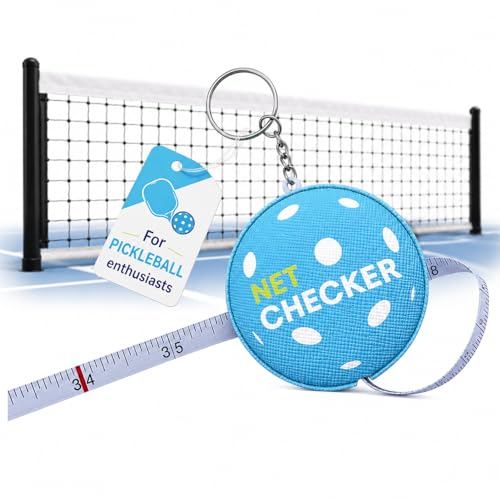
- Easy to Use: The markings on the tape indicate clearly what the height of the net should be at its center; Additional information about net height is listed at the back of the
- High Quality Measuring Tape: The 59 inch (150 cm) measuring tape is durable and portable, ready to be pulled out; To retract, simply press the Net Checker lightly
The Challenge: Why Backyard Courts Come Out Crooked
Most DIY courts fail for one of three reasons. The layout is a parallelogram instead of a rectangle because nobody squared the corners. The kitchen line was measured from the net posts instead of from the net centerline. Or the tape sagged and drifted over a long pull, so the "straight" sideline bows by an inch or two.
None of that is fixed by a better tape measure. It's fixed by a sequence.
Step-by-Step: How to Lay Out a Regulation Court
- Copy the official numbers first. Write the rulebook's court length, court width, non-volley zone depth, service area depths and net heights on paper. Work from that sheet, not from memory.
- Choose and sweep the surface. Adhesive lines and fabric lines both need a clean, dry surface. Sweep grit, leaves and dust off the whole footprint before a single strip goes down.
- Set one baseline as your master line. Snap or string one baseline dead straight. Every other line references this one, so any error here multiplies.
- Square the first corner with 3-4-5. From the corner, measure 3 feet along the baseline and 4 feet along the intended sideline. Adjust until the distance between those two points is exactly 5 feet. Scale it up to 6-8-10 or 9-12-15 for a longer, more accurate reference.
- Run the sidelines and the far baseline. Use the rulebook lengths, pulling each tape taut. Have a second person hold the dumb end; a sagging tape reads long.
- Check the diagonals before you commit. Corner to opposite corner, both ways. If the two diagonals are not identical, the rectangle is skewed and must be nudged before any tape or paint goes down.
- Mark the kitchen line. Measure the non-volley zone depth from the net centerline outward on both sides, at both the left and right sidelines, then connect those two marks. Measuring from a single point invites a crooked kitchen line.
- Add the centerlines. Split the space between the kitchen line and each baseline to define the two service courts on each end.
- Set the net and verify its height. Net height is a separate measurement from the layout and is checked at the center, where the net sags most.
- Re-measure everything before it becomes permanent. Tape and fabric lines forgive a redo. Paint does not.
Recommended Products for Court Layout
> Recommended Products: For a gym floor, the Quick Court Indoor Pickleball Court Marking Tape covers the full line set in one roll. For a driveway or a shared surface you have to clear after play, the Cortable Temporary Pickleball Court Lines skips the measuring stage entirely. For net height, the Scoring Right Pickleball Net Height Measuring Tape and Keyring is a pocket-sized check.
Quick Court Indoor Pickleball Court Marking Tape — Best for gym floors and shared indoor facilities
This is the option for anyone laying a court on a finished indoor floor. The listing for the Quick Court Indoor Pickleball Court Marking Tape states that each 230-foot roll is designed to lay out one complete USAPA regulation indoor pickleball court with a little spare. That single-roll coverage matters practically: you are not splicing ends mid-sideline, which is where visible kinks usually appear.
That listing describes the adhesive as formulated to bond securely to smooth indoor surfaces like hardwood, vinyl and finished gym floors, and names churches, schools, community centers and multi-use facilities as the intended settings. It also states the tape tears by hand and can be repositioned during installation, and that a QR code on the roll links to court layout instructions with official dimensions. The listing says the tape peels up cleanly without leaving sticky residue behind.
Strengths: hand-tearable and repositionable, which suits the diagonal-check workflow above; one roll per court.
Limitations to weigh: the supplied listing information positions this product for smooth indoor floors and does not state performance on asphalt, concrete or sport tile outdoors. Treat rough outdoor surfaces as unverified rather than assumed.
Cortable Temporary Pickleball Court Lines - Original Portable Pickleball Court Marking Kit — Best for driveways, HOA-sensitive spaces and pop-up courts
Look, this one sits in tension with the whole premise of this article, and that's the point. Cortable's listing says the kit requires no measuring, marking or assembly, weighs about 3 pounds, and rolls up to about the size of a shoebox. If your goal is playing this afternoon rather than building a permanent court, the layout math is already done for you.
The listing describes a patent pending design built from ultra thin, super strong fabric less than 0.05 inches thick that does not interfere with play. Cortable also markets the kit as homeowners association friendly because it can be removed and stored when not in use.
Strengths: portable, reusable, removable, and it eliminates the squaring step that trips up most first-timers.
Limitations to weigh: the supplied listing information does not state the exact court dimensions the lines produce or a regulation conformance figure. If you need a court for sanctioned play, confirm those dimensions with the manufacturer before buying.
Scoring Right Pickleball Net Height Measuring Tape and Keyring — Best for verifying net height at the center
Court layout and net height are two different jobs, and this tool only does the second. The Scoring Right listing describes a 59 inch (150 cm) retractable tape marked with red lines that indicate the required height of the net, with the required net height also printed in white on the back of the device. The listing says the markings indicate what the height of the net should be at its center.
The practical read: a pre-marked tape removes the arithmetic step at the net, which is useful when you're checking a portable net that's been packed and re-pitched. The listing puts the weight at 1.12 ounces and the size at no bigger than 3 inches, with a keyring so it clips to a bag.
Limitations to weigh: at 59 inches of tape, this is a net-height checker, not a court-layout tape. You still need a long tape measure for the 3-4-5 squaring and the sidelines.
Tips for Best Results
- Mark reference points with chalk first, then lay tape over the confirmed marks.
- Re-check the diagonals after the sidelines are down. Tape can pull a line off true.
- Sweep the surface twice: once before layout, once right before adhesive contact.
- Keep the rulebook page visible on your phone the entire time.
Common Mistakes to Avoid
- Measuring the kitchen from the net posts instead of the net centerline.
- Trusting a single diagonal check instead of comparing both.
- Letting one person pull a long tape alone, which produces sag and an over-long reading.
- Applying adhesive tape to a dusty floor.
- Painting permanent lines before a full re-measure.
How We Research
This website does not run a lab and does not do product research. For this guide, the three products above were assessed from their Amazon Creators API verified product records and their published listing feature bullets, retrieved 11 September 2026, and the conclusions drawn are limited to what those listings actually state. Where a listing is silent on a spec, this page says so rather than filling the gap.
Final Verdict
If you're marking a gym or multi-use indoor floor, the Quick Court Indoor Pickleball Court Marking Tape is the logical buy, because its listing specifies one 230-foot roll per complete USAPA regulation indoor court and describes the tape as repositionable during installation, which fits a careful measure-then-commit workflow. If you're playing on a driveway and need the lines gone by dinner, the Cortable Temporary Pickleball Court Lines kit trades dimensional transparency for speed and a stated 3-pound, shoebox-sized package. The Scoring Right net height tape is a small add-on, not a layout tool, and should be treated that way.
Related Resources
- Portable pickleball net setup
- Choosing pickleball shoes for outdoor courts
- Pickleball paddle buying guide
- For recalls and general consumer product safety information, the CPSC publishes guidance at cpsc.gov. USA.gov maintains consumer protection resources for purchase disputes at usa.gov.
Sources & Methodology
Nobody here measured a court, rolled out a line kit, or timed an installation; this site performs no physical or laboratory testing and says so on every page. What was done is a close reading of each product's Amazon Creators API verified product record and its published listing feature bullets as retrieved on 11 September 2026, with attention to what each seller claims and, just as importantly, what each listing leaves unstated. For court-marking gear, that level of evidence is enough to tell you which product is designed for which surface and how much coverage a seller promises per package, but it cannot tell you how a given adhesive behaves on your specific floor after a season of play, and it is no substitute for the official dimensions printed in the current USA Pickleball rulebook.